Rules & Regulations to Be Followed For Construction of Residential Buildings
The
building
byelaws for residential buildings
are set forth in such a way that, it should meet all the standards and specifications designed for necessary protection.
This will help not only to the laborers before starting, during construction to the health and safety point of view but also to the general public and visitors.
Building Byelaws for residential buildings and Regulations
:
The
building
byelaws
oversee the following rules and regulations of building features.
Set back or building line
Floor Area Ratio (FAR) or Floor Space Index (FSI) or Total built-up area
Open space requirements all over the building
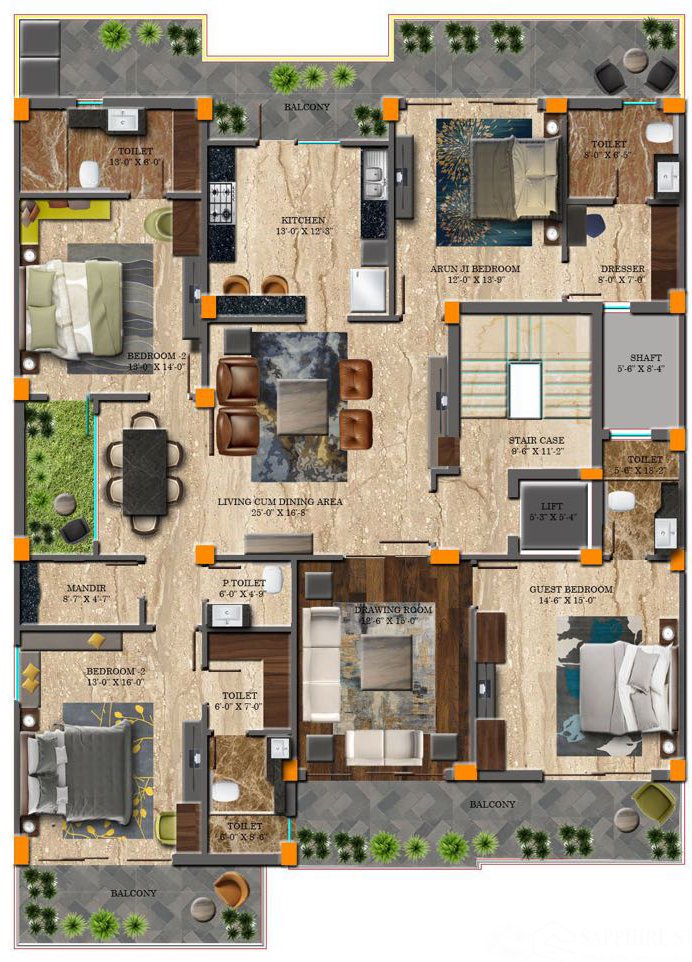
Plan showing internal dimensions of rooms, kitchen, living, etc.
Cross-sectional details showing the height of building and floor height.
Lighting & ventilation of rooms.
Structural details and designs
Fig 1. Building plan showing setbacks, FAR, internal dimensions, etc. as per regulations of Building Byelaws
Set back or building line
:
Set back is nothing but the open space available between the front of the building and road (Ref. Fig 1). The merits of the setbacks are as follows.
Open Space :
The open space left in front of the building is highly an advantage under the circumstances of widening the road in future time.
The Government will acquire this space as per rules and regulations.
If all the buildings parallel to the road follows the setback rules and construct accordingly the aesthetic of the locality will improve (E.g. Plots situated in many gated communities. Refer Fig 2)
Setbacks :
The air, ventilation, and light of the buildings is sufficient if setbacks maintained to the plots.
The open space can be utilized for gardening or vehicle parking purpose.
The marginal distance always helpful for the building in case of heavy traffic and other nuisance.
The possibilities of fire accidents will reduce due to the increased distance between opposite sides of buildings.
Fig 2: Houses in Gated community as per Building Byelaws regulations
2. Floor Area Ratio (F.A.R) or Floor Space Index(F.S.I) or Total built-up area
: Total Built-up area = Total Site area – All Open spaces area
Sum of All floors area
Floor Area Ratio (F.A.R) = ——————————-
Area of the site
Floor Area = Built-up area – Area of wall thickness.
The local gov. authority or the secondary authority is responsible for governing the value of F.A.R, is different for different zones and type of buildings in the sector. The F.S.I can be utilized for checking the density of the population. E.g. if the plot area is 1200 Sqft and if the allowable F.S.I is 0.8, then the maximum built-up area allowed for the plot is 960 Sqft.
As per the National Building Code (NBC-2016) for clear understanding, the built-up area versus plot area is as follows.
SL. NO.
Plot Area
Max. Allowable built-up area
1
Less than 200 sq. m
60% with 2 storied structure
2
From 200 – 500 sq.m
50 % of the plot area
3
From 500 – 1000 sq.m
40% of the plot area
4
Above 1000 sq.m
33.33% of the plot area
3. Open space requirements all over the building:
As per NBC, the open space for different heights of buildings is listed below.
Sl. No.
Height of building
Open space (setback) requirement
1.
< 10 m
a) Front setback or open space width:
i) For a building with front road – min. 3 m.ii) For a building with roads on 2 or more sides –Average 3 m and in no case < 1.8 m
b) Rear setback
– Average 3 m and in no case < 1.8 m
c) Side setback
– Min. 3 m for every detached & semi-attached building
d) Distance from the centerline of any road
– In no case < 7.5 m or as determined by the local authority
2.
From 10 m – 25 m
Requirement as per above item no. 1 is increased at the rate of 1 m for every 3 m or fraction thereof.
3.
From 25 m – 30 m
Minimum 10 m.
4.
> 10 m
Min. 10 m. is increased by at the rate of 1 m for every 5 m or fraction thereof subject to a max. 16 m
Section: As per table 2 of section 8.2.3.1 of part III of N.B.C.
SL. No
Height of building in Meters
Exterior open spaces/setbacks to be left on
all
sides. Minimum in meters
1.
Above 9.5 up to 12
4.5
2.
Above 12 up to 15
5.0
3.
Above 15 up to 18
6.0
4.
Above 18 up to 21
7.0
5.
Above 21 up to 24
8.0
6.
Above 24 up to 27
9.0
7.
Above 27 up to 30
10.0
8.
Above 30 up to 35
11.0
9.
Above 35 up to 40
12.0
10.
Above 40 up to 45
13.0
11.
Above 45 up to 50
14.0
12.
Above 50
16.0
4. Plan showing internal dimensions of rooms, kitchen, living, etc.:
As per NBC the minimum areas or sizes for individual rooms and apartments are listed below. (Ref. Fig 3)
Sl. No.
Type of room
Minimum area
1
One habitable room
9.5 sq.m, Min. width – 2.4 m
2
Two habitable rooms
Min. area of 1 room 9.5 sq.m & of other 7.5 Sq.m with min. width of 2.4 m
3
Kitchen only
4.5 sq.m, Min. width 1.8 m
4
Kitchen including storeroom
5.5 sq.m, Min. width of the kitchen – 1.8 m
5
Kitchen cum dining room
9.5 sq.m, Min. width 2.4 m
6
Bathroom
1.8 sq.m or Min. size 1.5 m x 1.2 m
7
Water closet (WC)
1.1 sq. m Floor Area
8
Bath & WC combined
2.8 sq.m (Floor area) – Min. width 1.2 m
9
Mezzanine floor (Living room )
9.5 sq.m ( > 1/3
rd
of the plinth area of the Building)
Fig 3. Three dimensional Plan showing all rooms, kitchen, living, etc. as per regulations of Building bye-laws
5. Cross-sectional details showing the height of the building and floor height:
As per NBC the height of the building is corresponding to its road width is listed below.
Sl. No.
Height of the building
Width of the Road
1
General criteria – 1.5 times the width of the road
–
2
Not more than 12 m
Above 8 m or Equal to 12 m
3
Not more than road width and not > 24m
Above 12 m
6. Lighting & ventilation of rooms:
To get proper air and ventilation to the rooms of the building, all openings such as windows, ventilators, or direct openings are provided at suitable places.
Sl. No.
Openings of the building
The floor area of the room
1
For dry and hot climate excluding door areas
Min. 1/10
th
of floor area
2
For Wet hot climate excluding door areas
Min. 1/6
th
of floor area
3
The total doors, windows, and ventilators
< than 1/7
th
of floor area
7. Structural details and designs:
The detailed structural design analysis and calculations for each and every component of the building has to be done and considering all forces of loads, earthquake, SBC, etc. by applying appropriate IS codes. However the general thumb rules are as follows.
a) Depth of foundation
0.75 – 1.0 m for one-storied building below GF 1.00 – 1.3 m for two-storied building below GF
b) Width of the foundation wall
2 times the thickness of the wall just above the plinth + 30 cm
c) Concrete in the foundation wall
5/6
th
of the thickness of the wall above the plinth
So, these above 7 headings are the Building ByeLaws for Residential Buildings one should always keep in mind while go for construction of their houses.